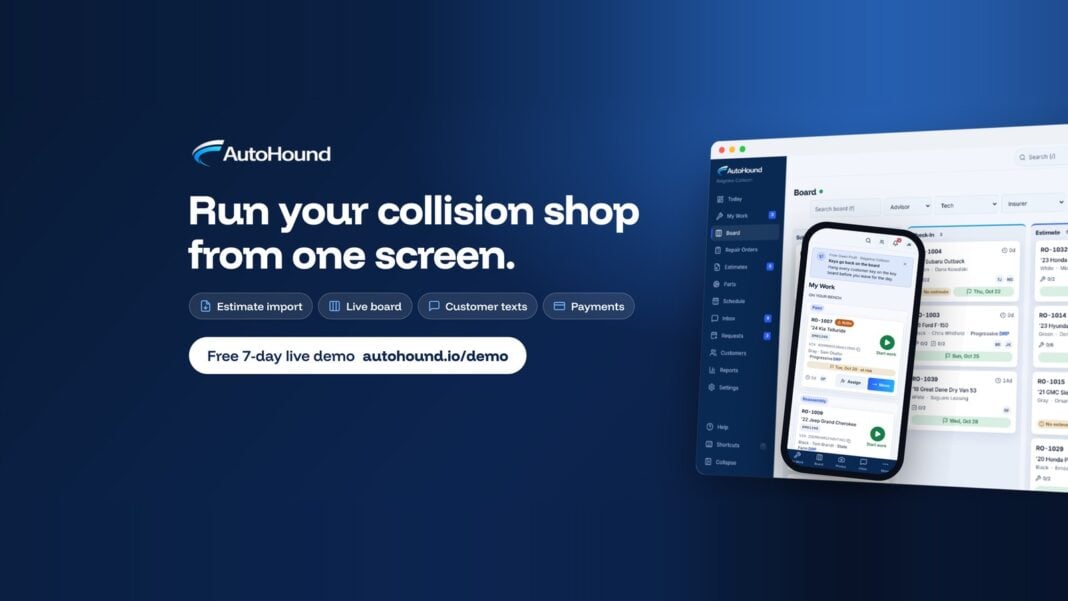

Walk into an independent collision shop and the work on the floor is only half the job. Behind the paint booth and the frame bench sits a stack of software: an estimating platform, a parts system, a way to text customers, a scheduling tool, an accounting package, and whatever the insurer’s workflow asks for that week. For years, much of that software has come from a relatively small number of established providers, and shop owners have learned to live with complicated pricing, separate add-ons and systems that do not always talk to each other.
AutoHound, a technology company based in Austin, Texas, was founded to question that arrangement. Its pitch is not a single feature. It is the claim that an independent shop should be able to run a repair, from the first booking to the moment the keys go back to the owner, on one connected system at a price it can predict.
One price, every feature
AutoHound charges $599 a month per location. That covers unlimited users and every feature on the platform, with no setup fee and no annual contract. Shops pay month to month and can cancel at any time.
In a market where business software is often sold by the seat, by the module or by the add-on, that structure is the argument. “We’re challenging the notion that sophisticated business software needs complicated pricing or expensive licensing models,” the company says.
The platform brings production management, parts tracking, customer communication, scheduling, reporting and payments into one repair order. A live production board shows every vehicle by stage, customers get text updates, and owners get reports on the whole operation. Shops keep the estimating system they already use: AutoHound picks up estimates and supplements from CCC ONE, Mitchell, Audatex and AdjustRite rather than asking anyone to switch.
Built from both sides of the shop door
The founding team brings together enterprise technology, automotive manufacturing, collision repair, automotive refinish and business operations. Co-founder and CEO Simon Laurinavicius brings experience from PPG, pairing refinish industry knowledge with business technology. Co-founder and CTO David King has spent more than a decade designing and delivering complex technology for Fortune 100 organizations and automotive manufacturers.
That mix shaped the hardest problem the company has faced. Collision repair software does not work in isolation. A shop depends on estimating platforms, insurance workflows, parts suppliers and accounting systems, and a new management platform has to fit into all of them. The established providers have had decades to build those integrations and the relationships behind them.
AutoHound chose to work with the industry’s shared data standards rather than around them, and joined the Collision Industry Electronic Commerce Association, CIECA, the body behind those standards. “We believe improving interoperability requires collaboration across the industry,” the company says.
The case for being small
David-and-Goliath stories usually end with the giant on the ground. AutoHound tells its own differently. It does not argue that the larger providers have it wrong. It argues that size carries its own constraints, and that a young company without them can move faster.
“Without layers of bureaucracy or decades of legacy technology to maintain, we can make decisions quickly and respond directly to customer needs.”
In practice, that has meant staying close to the shops on the platform and building around the problems they raise. “Software developers can build impressive technology, but if it doesn’t address the realities of the people using it every day, its value is limited,” the company says.
The same thinking runs through its work on artificial intelligence. Through the Model Context Protocol, a shop owner can let office staff connect their own Claude or ChatGPT account to the shop’s system, so a manager can review the day’s workload before the morning huddle or prepare for a call with an adjuster. When the assistant is asked to change something, such as moving a repair to its next stage, the user confirms it first.
The freedom to leave
The part of the pitch that sounds least like a sales line may be the most unusual. AutoHound lets shops export their data, documents and images at any time, without opening a support ticket, and says it never sells shop data.
“We would rather earn a customer’s business every month than rely on contractual or technical barriers to keep them,” the company says.
For independent shops, that matters more each year. As the collision repair industry continues to consolidate, independents compete against national chains with deep budgets for technology. AutoHound’s aim is to put the same operational tools within reach of a single-location shop without asking it to give up its independence or its data.
What success would look like
The company wants to become one of the leading technology platforms for independent collision repair businesses, first across the United States and later in international markets. Its longer ambition is a connected ecosystem that links shops with their customers, their suppliers and the information they need to make decisions.
It also describes a measure of success that has little to do with its own market share. “If AutoHound’s success encourages the rest of the industry to improve pricing transparency, interoperability, and customer experience, we’d consider that a meaningful accomplishment too.”
The lesson it draws is one any challenger in a settled market would recognize. “Being an established market leader doesn’t necessarily mean delivering the best possible customer experience,” the company says. Innovation, in its telling, does not always mean inventing something new. “Sometimes it means taking something unnecessarily complicated and making it simpler, more accessible, and more affordable.”
AutoHound is an Austin, Texas technology company building shop management software for independent collision repair businesses.
autohound.io · LinkedIn · Facebook · YouTube