
The Holy Bible, one of the world’s oldest books, foretold thousands of years ago, the love for money is the root of all kinds of evil, and those same words remain just as true today. Money compels the human soul to befriend, exploit, and betray the known and the unknown. The obsession for money can easily lead to trouble. Love of money leads people to concoct all kinds of schemes and commit crimes to take what belongs to someone else.
Technology theft is no different.
In today’s powerful digital world, where most decisions are influenced by online information, the importance of customer reviews cannot be overstated.
When online businesses encourage customers to leave reviews, it builds connections with the customers, which fosters a sense of community and engagement. Online reviews also help online entrepreneurs to operate their businesses more efficiently.
False Google Reviews
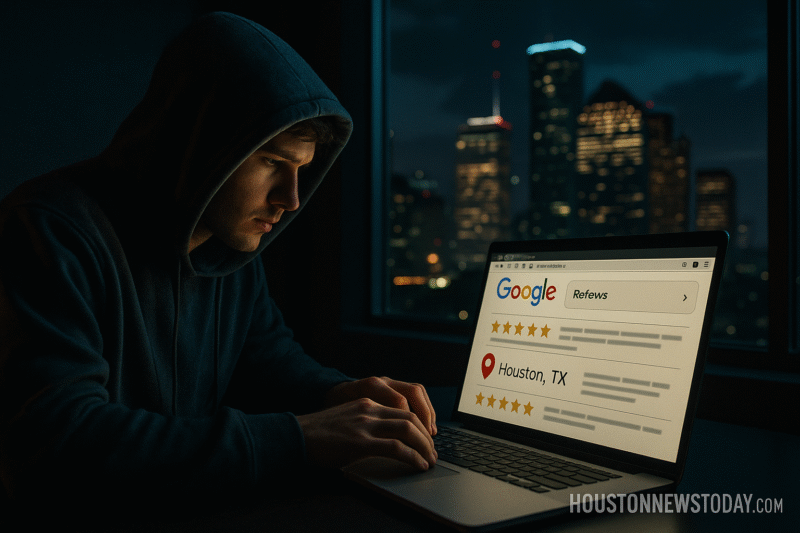
When potential customers read about the positive experiences of previous customers, they are more inclined to make a purchase. Hi-tech extortionists know this. So, they flood businesses with fake negative reviews by posting the reviews on the website owned by a particular business.
“There exists an underworld behind the online content people are unaware of,” Fake Review Watch host Kay Dean told NY Times reporter. Dean’s investigation identified at least 150 businesses worldwide affected by fake negative reviews.
Consultants and tech fraud specialists predict fake reviews will cost online consumers worldwide $1.10 trillion in unwanted purchases by 2030. “We’re facing a crisis that threatens the foundation of digital commerce,” writes Clean-rep.com.
The numbers are alarming, according to clean-rep: 82% of consumers encounter fake reviews at least once over 12 months, and an average of 30% of online reviews are considered fake or ungenuine.
However, since many small businesses rely on recommendations for business, massive reams of fraudulent reviews and fake testimonials has triggered an extremely disturbing trend in the Bayou city of Houston, Texas, and throughout the nation.
It’s no secret how fake reviews harm businesses by making it more difficult for consumers to believe what they read online. Unethical actors who post unfavorable evaluations often target small businesses and some larger ones as well.
Hoping to reduce the problem, (FTC) Federal Trade Commion dropped the hammer against those perpetuating fake reviews online. The rule took effective Oct. 21, 2024. FTC also fine(fake review)violators $51,000 per violation. In addition to fines the FTC will issue civil penalties against businesses engaging in buying or generating fake online reviews to manipulate Google reviews.
“Fake reviews not only waste people’s time anod money, but ralso pollute the marketplace and divert business away from honest competitors,” said FTC Chair Lina M. Khan. She added that the rule will “protect Americans from getting cheated, put businesses that unlawfully game the system on notice, and promote markets that are fair, honest, and competitive.”
Clean Reputation reports that:
- Hotels face sophisticated blackmail schemes where criminals demand thousands in payment to prevent fake one-star review campaigns
- Independent or single-unit hotels and restaurants are the primary beneficiaries of review manipulation and are, therefore, more susceptible to it.
- In one case in Australia a plastic surgeon claimed that his business dropped by 23% in the week after a fake review was posted
Review Trackers Detect Fake Reviews
How to Spot Fake Reviews: 6 Easy Steps | ReviewTrackers
Hi-tech Crooks Hit Houston’s Small Business Communities
Recently, according to local news media outlets, in a ransom-style extortion scheme, several Houston eateries, including Georgia James on West Dallas, Daily Gather, Loch Bar, Piatto Ristorante on West Alabama street, and Bludorn located in Houston’s Montrose area were inundated with one-star Google reviews.
Each restaurant received a suspicious email, allegedly from India, threatening to continue the daily barrage of one-star reviews unless they receive a $75 Google Play gift card. This hi-tech scheme is nonetheless an organized extortion that’s been happening to many restaurants across the nation, including places in Chicago, New York, LA, Washington, San Francisco, and other places. Restaurateurs were forced to decide whether to pay the ransom, potentially encouraging more attacks, or suffer the financial consequences of a lower rating.
The scam artists are blunt and to the point. Unfortunately, a message said, negative feedback about your establishment has been left by us. And will appear in the future, one review a day.
“We sincerely apologize for our actions, and would not want to harm your business, but we have no further choice,” the bad actor writes in emails sent to several local restaurants. “The fact is that we live in India and see no other way to survive.”

(Contact Google if Fake Reviews Appear on Your Business Website
Report inappropriate reviews on your Business Profile – Google Business Profile Help)
Cherif Mbodji, co-owner and general manager of Bludorn, said last year on July 13, that his friend, a small restaurant owner, had first received several one-star reviews and the threatening email. Days later, Bludorn received the email and a blitz of low reviews sans comments. Mbodji said he and chef Aaron Bludorn, co-owner of the restaurant, quickly acted, reporting the reviews to Google as harassment, but Mbodji said the company noted that there was nothing wrong with the review and declined to remove them.
Bludorn said though the ransom attack is seemingly unsophisticated, it made the restaurant’s Google rating drop from 4.8 to 4.5 in one week with just seven one-star reviews. An outpouring of support from the community onTuesday, July 12, 2024, resulted in around 100 5-star reviews in one day – but the rating only increased to 4.6. The scammers have reportedly doubled down. In a subsequent email, Mbodji said the scammer asked: “Is this really worth the loss of business?”
Newer victims include Maison Pucha Bistro, Field & Tides, and Georgia James, the steakhouse spearheaded by James Beard Award-winning chef Chris Shepherd. Georgia James’ management fought back, responding to the reviews on Google directly, many of which have since been removed. A 2024 Houston report highlighted a virtual receptionist service that saw a dip in new client inquiries due to fake reviews, leading to a temporary but significant decrease in revenue.
Aside from bogus reviews lower star ratings and public scrutiny as result of fake reviews can drive customers to competitors, which leads to a company’s lost revenues. A national report estimated that fake online reviews cost U.S. businesses nearly $152 billion annually resulting from lost business and reputational damage.
Positive Reviews Bring Cha-Ching
Consumers are more likely to trust a business with positive reviews. According to research, 84% of people trust online reviews as much as personal recommendations. This trust can significantly influence purchasing decisions, making it crucial for small businesses to cultivate a positive online presence.
Search engines, like Google, prioritize websites with positive reviews in their search results. Small businesses with numerous positive evaluations often rank higher, leading to increased visibility and attracting potential customers. A consistent flow of positive reviews can help a person’s business show up in local search results, driving traffic to their website or brick-and-mortar store.
In a story published by the Associated Press, Avi Israeli, a dentist who owns Sage Dental in Wall, New Jersey, which employs 15 people, claimed that false and inaccurate reviews from individuals unrelated to his office have targeted his practice.
Furthermore, individuals from neighboring states mistook his clinic for a chain that shares the same name. As mentioned, small business owners are increasingly becoming targets of scam artists who inundate Google Maps and various other platforms with deceptive negative reviews, subsequently extorting the business owners by offering to remove these reviews for a fee.

New York Times reported how L.A., Calif., contractor Natalia Piper received a WhatsApp message from a ‘number’ based in Pakistan during the summer. The message alerted her that someone had commissioned 20 unfavorable reviews for her business.
Shortly thereafter, her company’s previously impeccable 5-star Google rating plummeted to 3.6, resulting in a loss of customers and revenue. Piper, along with other small business owners, was pressured to pay for the removal of the fraudulent reviews. She ultimately made payments totaling $250 in two installments before realizing that the cycle of extortion would not cease.
“It took me eight years to establish my reputation in the market, and one individual can undermine it in a single day,” she remarked. A system susceptible to exploitation This scam operates by inundating small, review-reliant enterprises-ranging from moving services to roofing contractors and appliance repair companies with fictitious one-star Google ratings.
The perpetrators subsequently demand payment to eliminate these posts. As previously stated earlier, the industry watchdog, Fake Review Watch documented over 150 businesses worldwide affected by the scheme.
“Businesses are being extorted, and Google is not taking sufficient action to address this issue,” stated Kay Dean, the host of Fake Review. Dean is a former federal criminal investigator. She noted that scammers leverage artificial intelligence tools to generate convincing reviews on a large scale, complicating moderation efforts.
Google Facing Scrutiny
Google, like other platforms such as Amazon and Yelp, removes millions of fraudulent reviews annually, yet the tech giant acknowledges that many still evade detection. In a statement, the company asserted that it generally blocks deceptive content before it appears and has suspended over 900,000 accounts for violations.
Officials promised the development of a new tool to assist businesses in reporting when they are targeted, although no timeline has been provided. Victims express that obtaining assistance from the technology giant is nearly impossible.
Businesswoman Piper indicated that she pursued multiple channels, including Google’s advertising division, where she invested thousands of dollars-yet she still experienced minimal success.
A System Ripe for Abuse
The scam works by flooding small, review-dependent businesses, from moving companies to roofers and appliance repair services, with phony one-star Google ratings. The attackers then demand money to delete the posts. Industry watchdog Fake Review Watch has tracked more than 150 businesses worldwide targeted in this way.
“Businesses are being extorted, and Google isn’t doing enough about it,” said founder Kay Dean, a former federal criminal investigator, in the Times report. She said scammers use AI tools to churn out convincing reviews at scale, making moderation even harder.
Google Under Fire
Google, like Amazon and Yelp, removes millions of fake reviews each year but admits many slip through. In a statement, the company said it blocks fraudulent content before it appears in most cases and has suspended more than 900,000 accounts for violations. Officials promised a new tool to help businesses report when they are being targeted but gave no timeline.
Victims say getting help from tech giants is nearly impossible. Piper said she tried multiple channels, even through Google’s advertising department, where she spent thousands with little success.
Small Businesses
In Georgia, moving company owner Nick Betourney also saw his hard-won 5-star rating threatened. He received a WhatsApp note from a man using the name Rashid Ghallu, who later admitted to The New York Times that he sells negative Google reviews for $100 per batch of 20.
The scammers’ reviews weren’t generic complaints, Betourney said, but “crazy elaborate stuff” describing boxes smashed in front of customers. Google eventually removed some of the fakes, but new ones quickly appeared.
Limited Protections Despite New Rules
Although Federal Trade Commission in 2024 introduced rules targeting businesses that buy fake positive reviews, but they don’t apply to platforms like Google or to scammers overseas. Under federal law, platforms enjoy broad protections for third-party content, leaving small businesses vulnerable.
For now, some owners are relying on their own fixes. Piper said removing her cellphone number from her online listings finally stopped the WhatsApp harassment. But she fears countless other small firms may not be as lucky.
Business Owners Alert: Learn to Spot & Report False Reviews
Consumer Affairs provides tips for online business owners to educate themselves about the hi-tech scammers whose mission is to extort money repeatedly from their businesses:
- Watch for sudden rating drops: A cluster of 1-star reviews appearing at once is a red flag.
- Closely observe reviewer profiles: Fake reviewers often have no profile photo and few past reviews.
- Check for copy-and-paste language: Repeated phrases or nearly identical wording across multiple reviews may indicate fraud.
- Report suspicious reviews to Google: Use the “Report review” option directly in Google Maps; it provides details explaining why it’s fake.
- Keep records: save screenshots of reviews and any related messages (emails, texts, WhatsApp) to document harassment or extortion attempts.
Avoid paying scammers because payment rarely stops the attacks and can invite more.
Contact Google if Fake Reviews Appear on Your Business Website
Report inappropriate reviews on your Business Profile – Google Business Profile Help
Need help? The FTC accepts complaints about online scams at reportfraud.ftc.gov.
Houston News Today Associate editor and Reporter C. Walker can be reached at houstonnewstoday@yahoo.com
Got a news tip or story idea? Email us at houstonnewstoday@yahoo.com and include the best way to reach you.